
August 2026
Finding EASE in Simply Being
So much of our lives is spent doing. Even when we intentionally make time to slow down, it can be hard to quiet the feeling that we should be doing something. We fill our weekends, plan our downtime, and pack so much into our vacations that we come home joking, "I need a vacation from my vacation."
There's a fine line between being productive and staying busy for the sake of being busy. Often, the doing isn't really about the to-do list. Sometimes, it's a way of staying ahead of something—an escape from feelings we'd rather not sit with, worries swirling in our minds, or even other tasks we'd rather not do. Other times, it may simply be that our body doesn't quite know how to rest, even when there's nothing left to do.
For many of us, this way of living took root a long time ago. In school, being busy meant getting good grades and being “well-rounded”—an attribute often regarded highly by universities in college applications. Later, we're taught that hard work gets rewarded and a busy life is proof of success. We learn that staying alert, prepared, and useful is part of being an effective adult. We get so used to constantly being on the move that we rarely give ourselves the chance to just be; to stop, unhook from the next task, and notice what's actually here.
Sometimes, what brings people to somatic work isn't a single crisis, but a slow-building sense of disconnection from themselves. Maybe the body is holding tension without an obvious reason. Maybe it's become difficult to know what you actually feel, want, or need, or your boundaries feel either too porous or too rigid. Sometimes, the nervous system has simply gotten used to bracing, even when nothing is currently wrong.
Talking about these patterns can help us understand them. But understanding a pattern and shifting it are two different things. Many of the ways we protect ourselves were never decided in words. They were learned in the body, sometimes long before we knew how to explain what we were experiencing. And shifting them may require more than thinking our way through them. It can mean having new experiences of feeling safe, of moving toward or away from closeness, of setting a boundary and discovering that it can be respected.
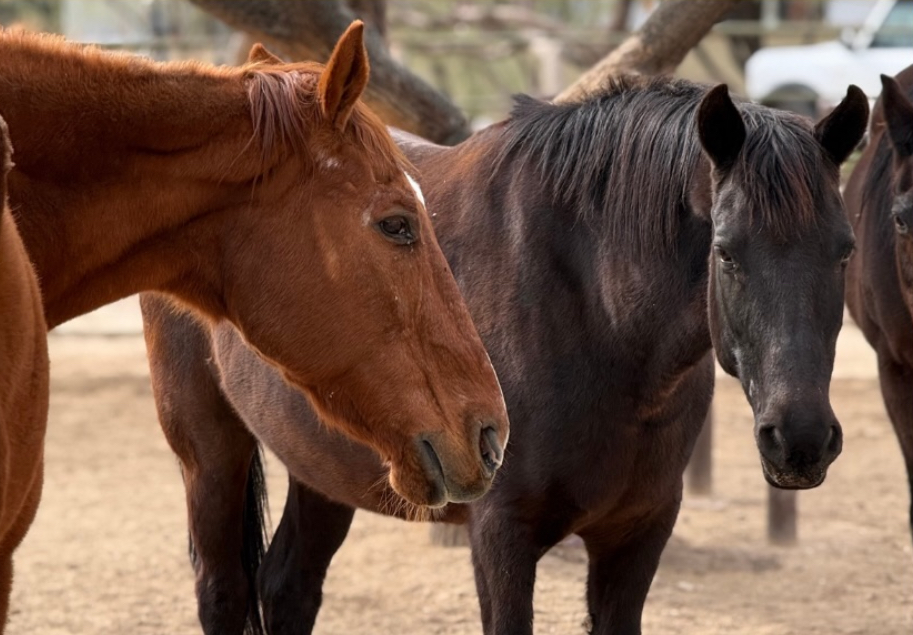
At Equinimity, this is where the horses come in. Horses don't ask us to explain ourselves. They don't need a tidy account of what we're feeling before they respond to us. They meet us as we are, responding to what's actually happening in our body and behavior rather than what we say about it. In their presence, it gets harder to perform a calm we don't actually feel. There are no pretenses with horses. Nothing to perform, nothing to plan ahead of. And that gives us vital space to notice.
Do I want to move closer, or do I need more space? Can I tell when something feels comfortable, or when it doesn't? What happens when I actually slow down enough to pay attention?
There's no right answer to any of that. There's just the chance to notice, sometimes for the first time in a long time.
This is the heart of our offering, EASE: Equine Assisted Somatic Experientials at Equinimity. EASE brings together tools from Natural Horsemanship with somatic practices for trauma healing, using our interactions with horses as a way to explore what can be difficult to access through words alone: how to meaningfully slow down, how to connect with others without losing connection with ourselves, how to deepen our capacity to listen to ourselves, how to communicate clearly, and how we experience boundaries and choice.
Rather than only talking about these things, EASE allows us to experience and practice them in real time. Each session is shaped around the person or small group in it, meeting whatever is present that day.
EASE gives us a chance to discover what happens when nothing needs to be accomplished for a little while. What happens when we enter a space without a plan, without a list of things to do, without needing the right words to say…
What if, for a little while, we simply let ourselves be?
Sometimes, simply being present is what allows us to notice what our body has been communicating all along. Perhaps we just need to slow down enough to hear it.
If you'd like to learn more about EASE and the space we create for this work alongside horses, please visit equinimitytucson.com/ease.